
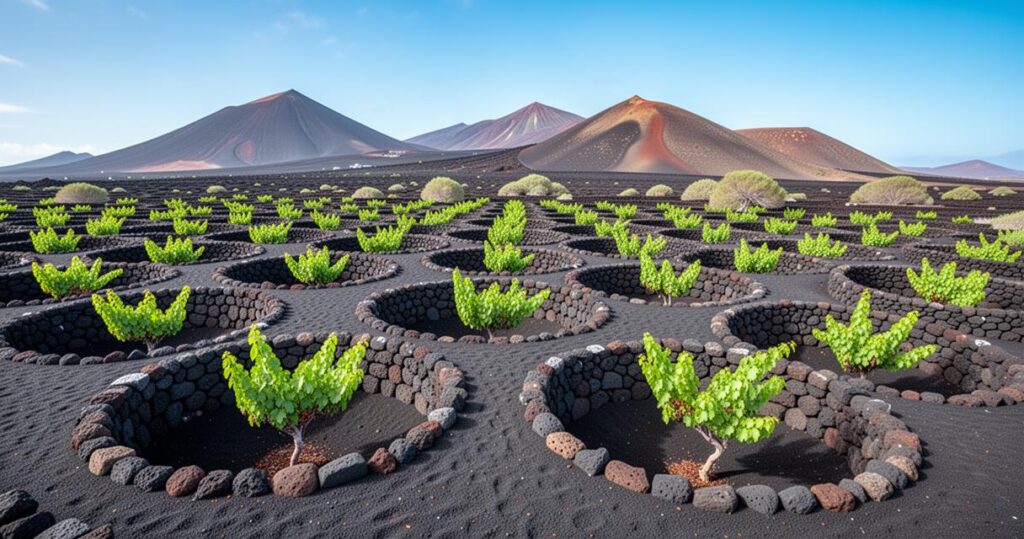
Few wine regions in the world demand as much ingenuity from their growers as La Geria, the volcanic heartland of Lanzarote. Stretching across the south-central part of the island, east of Timanfaya National Park and accessible via the LZ-30 highway, this landscape of black craters and low-lying vines looks unlike any other vineyard you are likely to encounter. What appears at first glance to be a lunar terrain is in fact the result of centuries of patient, skilful farming, a form of viticulture shaped entirely by volcanic forces and human resilience.
Key points
- The La Geria region uses a ‘heroic viticulture’ method, where vines are planted in volcanic ash pits known as picón to retain moisture without irrigation.
- Each vine is protected from intense sun and trade winds by a curved dry-stone wall called a zoco.
- Because the phylloxera louse never reached Lanzarote, the region features ancient, ungrafted vines that produce highly concentrated fruit.
- Malvasía Volcánica is the signature grape variety of the area, celebrated for its mineral depth and floral aromas.
- Bodegas EL GRIFO, one of Spain’s oldest wineries, preserves this winemaking heritage while practicing sustainable, regenerative viticulture.
- Visitors can explore the history of the region through guided tours, a dedicated wine museum, and seasonal harvest experiences at the EL GRIFO estate.
How Vines Survive and Thrive in La Geria’s Volcanic Landscape
To understand the La Geria vineyards, you first need to understand the land itself. Declared a Protected Landscape in 1994, this territory sits on a bed of volcanic ash deposited over centuries of eruptions. The island of Lanzarote is itself recognised as a Biosphere Reserve, a status that reflects both the fragility and the extraordinary character of its natural environment. Within this setting, growers developed an approach that the winemaking community now refers to as heroic viticulture, and the name is well earned. Indeed, EL GRIFO, the bodega at the heart of this region, has cultivated and refined these techniques since its founding in 1775, making it one of the ten oldest wineries in Spain.
Pits, picón and stone walls: the ingenious growing method behind la geria vineyards
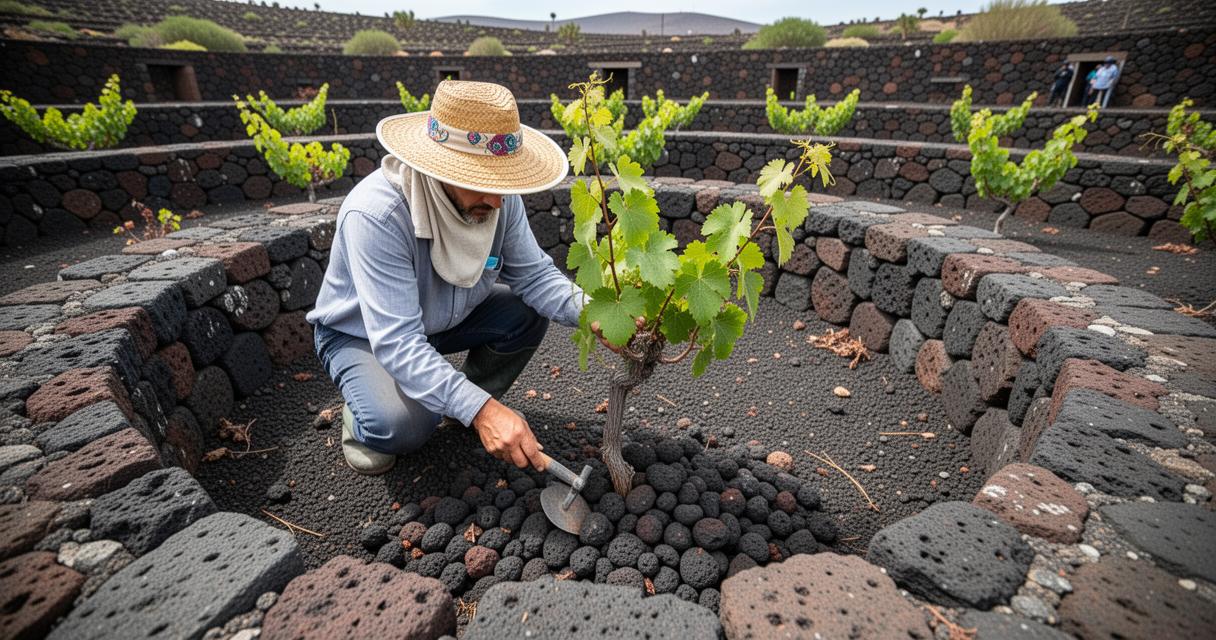
At the core of La Geria’s growing method is a deceptively simple solution to an extreme problem. Each vine is planted in a pit dug into the layer of volcanic ash known as picón. This porous, granular material absorbs the humidity of the night-time dew and retains it close to the roots, meaning the vine can hydrate without any irrigation at all, a remarkable feat in one of Europe’s most arid climates. Surrounding each plant, a low curved wall of dry stone, called a zoco, creates a sheltered microclimate that shields the vine from the fierce trade winds and the intensity of the Atlantic sun. The result is a patchwork of individual craters spread across the black earth, each one housing a single vine with extraordinary care.
This labour-intensive method brings low yields and considerable physical effort, but it produces wines with a distinctive volcanic character, intense mineral aromas, salinity and an elegance that reflects the land directly. The summer harvest, when grapes are gathered under the Canarian sun, is one of the most visually striking moments in the agricultural calendar of the island.
Ungrafted Vines and Native Grape Varieties Rooted in Centuries of Volcanic Terroir
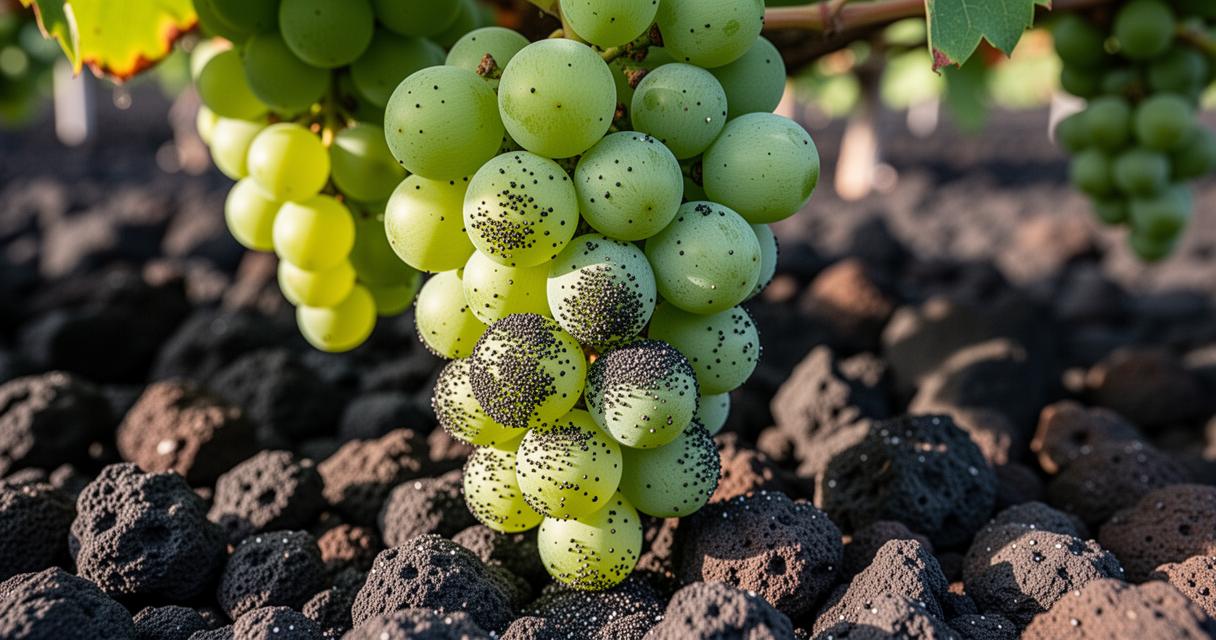
One of the most remarkable facts about Lanzarote’s vines is that phylloxera, the vine louse that devastated European viticulture in the nineteenth century, never reached the island. As a result, the vines here have never needed to be grafted onto resistant rootstocks, and many plants are genuinely ancient, with some reaching a century or more in age. These ungrafted vines produce fruit of singular concentration and complexity.
The native grape varieties grown across the La Geria Protected Landscape include Malvasía Volcánica, the flagship white variety whose floral fragrance and mineral depth have made it the emblem of Lanzarote wine; Listán Negro, the primary red grape, producing wines with a light texture and gentle spice; and Vijariego Blanco, another white variety with its own distinct aromatic profile. Beyond these dry styles, the tradition of producing ancient sweet wines also endures, offering a window into the island’s long viticultural history.
Visiting Bodegas EL GRIFO: Winery Experiences, Tastings and the Story of Lanzarote’s Wines
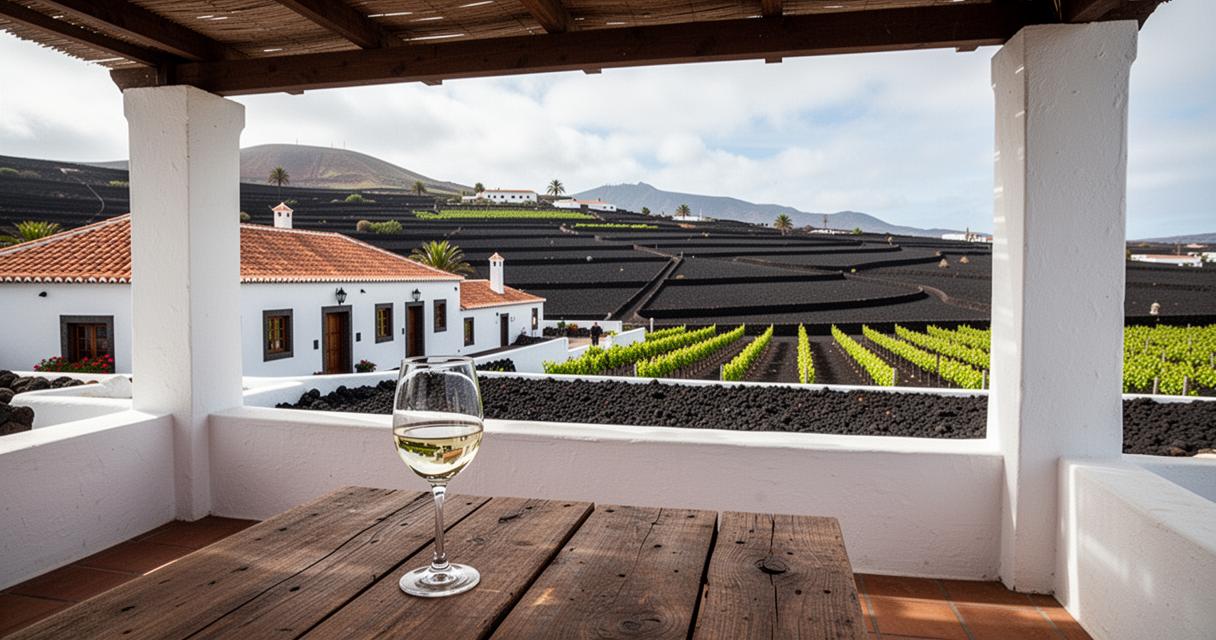
Bodegas EL GRIFO is far more than a producer, it is a place where the full story of Lanzarote wine comes alive. Founded in 1775 and situated at LZ-30, Km 11, 35559 San Bartolomé, Las Palmas, the estate sits directly within the heart of the La Geria landscape, making it one of the most naturally situated wineries on the island. Visitors arriving from Puerto del Carmen can reach the bodega in around ten minutes, while those travelling from Arrecife will find the journey takes approximately twenty minutes via the LZ-30.
Guided Tours, the Wine Museum and Harvest Experiences at EL GRIFO
The estate offers a range of visits and oenotourism experiences designed to suit different interests and levels of wine knowledge. Guided tours with commented tastings are available in Spanish and English, and can be booked through the bodega’s website. For those who prefer to explore at their own pace, a self-guided visit using an audioguide accessed on your phone is available in Spanish, English, French, Italian and German, and includes a tasting of two wines. Both formats are praised by visitors for being informative and accessible, welcoming both enthusiasts and those encountering wine culture for the first time.
The Wine Museum, housed in the original bodega building, is a highlight of any visit. It displays the estate’s original press and the founding stone dated to 1775, offering a tangible connection to over two centuries of winemaking history. During the summer harvest period, the bodega also organises Harvest Experiences, allowing visitors to witness and participate in one of the most important moments of the wine year. The on-site wine bar and boutique provide the opportunity to taste the wines in a relaxed setting and to purchase bottles to take home. Wines are also available for delivery across Europe through the bodega’s online shop.
Sustainable Viticulture and How to Plan Your Visit to La Geria
Bodegas EL GRIFO approaches its land with a commitment to organic vineyards and regenerative viticulture. The estate also operates the Oresteo system, which captures and reuses the CO2 produced during fermentation, reducing its environmental footprint at the point of production. Research carried out by the team covers adaptation to climate change, indigenous yeasts and the aromatic properties of Malvasía Volcánica, work that connects deep historical knowledge with forward-looking winemaking science.
Bodegas EL GRIFO
LZ-30, Km 11, 35559 San Bartolomé, Las Palmas
Téléphone : +34 928 52 40 36
Visitors arriving at the estate are welcomed by a cactus garden at the entrance and can enjoy a terrace for extended tastings. The bodega is open Monday to Friday, from 10:00 to 18:30, with the last access for visits and experiences at 17:15. It is closed on Saturdays and Sundays. To arrange your visit or to ask any questions, the team can be reached on +34 928 52 40 36. Whether you come for the wines, the landscape, or the history that connects them, a visit to EL GRIFO offers a genuine encounter with one of Europe’s most singular wine cultures.